Multithreaded Programming
Overview
- Thread Introduction
- Multithreading Models
- Threaded Case Study
- Threading Issues
Thread Introduction
Thread
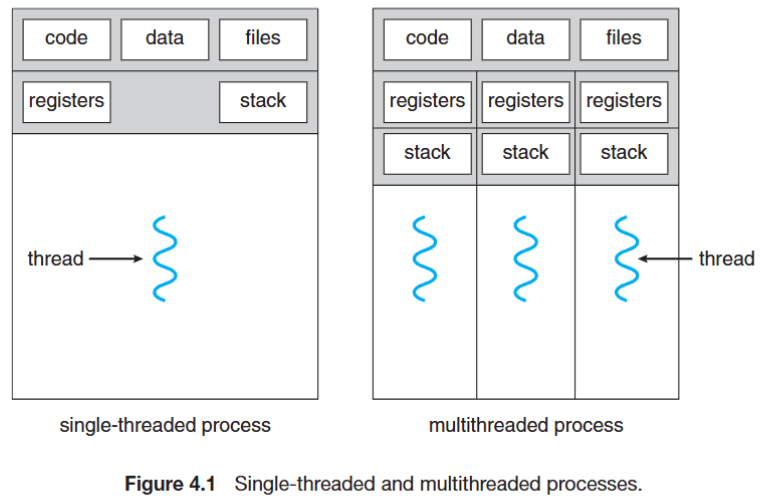
- thread a.k.a lightweight process: basic unit of CPU utilization
- all threads belonging to the same process share: code section, data section, and OS resources (e.g. open files and signals)
- But each thread has its own (thread control block): thread ID, program counter, register set, and a stack
Motivation
- Example: a web browser
- One thread displays contents while the other thread receives data from network
- Example: a web server
- One request / process: poor performance
- One request / thread: better performance as code and resource sharing
- Example: RPC server
- One RPC request / thread
Benefits of Multithreading
- Responsiveness: allow a program to continue running even if part of it is blocked or is performing a lengthy operation
- Resource sharing: several different threads of activity all within the same address space
- Utilization of MP (multi processor) architectur e: Several threads may be running in parallel on different processors
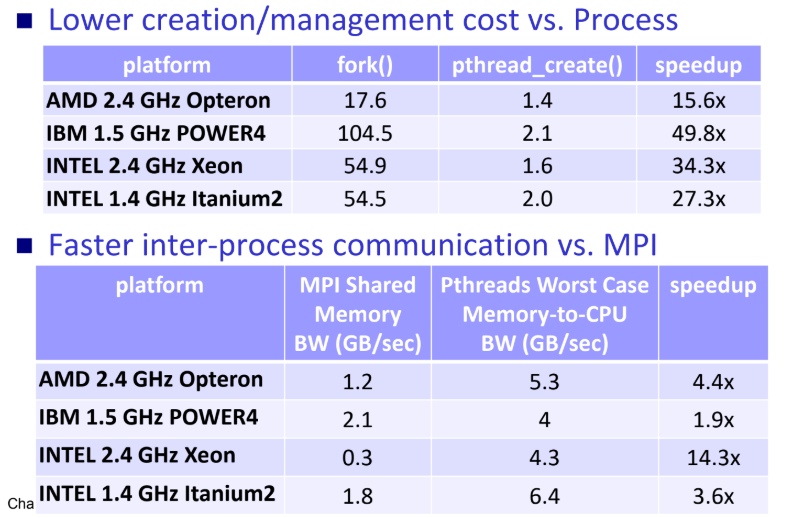
- Economy: Allocating memory and resources for process creation is costly. In Solaris, creating a process is about 30 times slower than is creating a thread, and context switching is about five times slower. A register set switch is still required, but no memory-management related work is needed
Why Thread?
Multithcore Programming
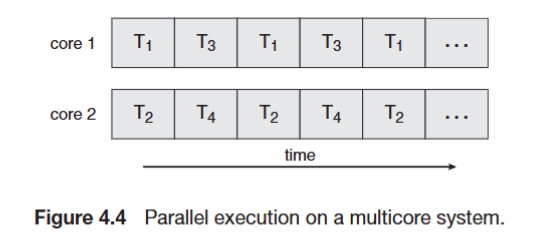
- Multithreaded programming provides a mechanism for more efficient use of multiple cores and improved concurrency (threads can run in parallel)
- Multicore systems putting pressure on system designers and application programmers
- OS designers: scheduling algorithms use cores to allow the parallel execution
Challenges in Multicore Programming
- Dividing activities: divide program into concurrent tasks
- Balance: evenly distribute tasks to cores
- Data splitting: divide data accessed and manipulated by the tasks
- Data dependency: synchronize data access
- Testing and debugging
User vs. Kernel Threads
User threads – thread management done by user-level threads library
- POSIX Pthreads
- Win32 threads
- Java threads
Kernel threads – supported by the kernel (OS) directly
- Windows 2000 (NT)
- Solaris
- Linux
- Tru64 UNIX
User threads
- Thread library provides support for thread creation, scheduling, and deletion
- Generally fast to create and manage
- If the kernel is single-threaded, a user-thread blocks -> entire process blocks even if other threads are ready to run
Kernel threads
- The kernel performs thread creation, scheduling, etc.
- Generally slower to create and manage
- If a thread is blocked, the kernel can schedule another thread for execution
Multithreading Models
Many-to-One
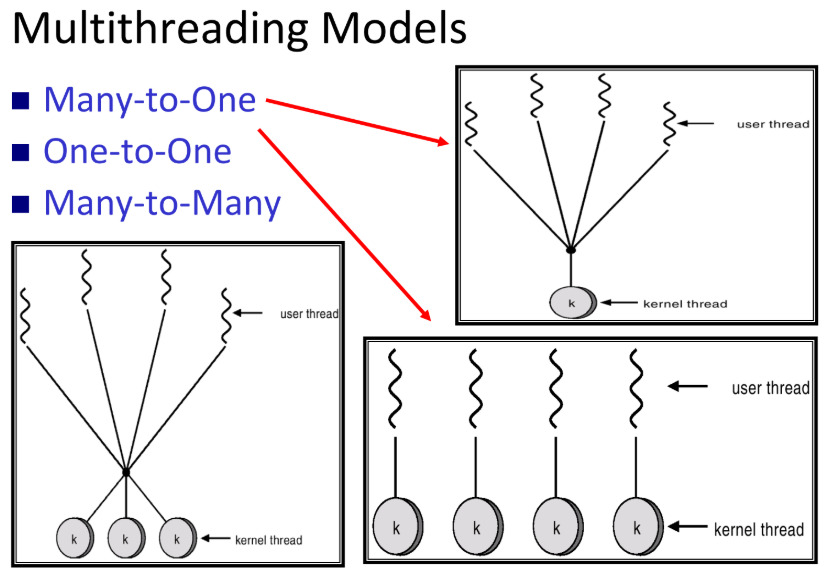
- Many user-level threads mapped to single kernel thread
- Used on systems that do not support kernel threads
- Thread management is done in user space, so it is efficient
- The entire process will block if a thread makes a blocking system call
- Only one thread can access the kernel at a time, multiple threads are unable to run in parallel on multiprocessors
One-to-One
- Each user-level thread maps to a kernel thread
- There could be a limit on number of kernel threads
- More concurrency
- Overhead: Creating a thread requires creating the corresponding kernel thread
- Examples
- Windows XP/NT/2000
- Linux
- Solaris 9 and later
Many-to-Many
- Multiplexes many user-level threads to a smaller or equal number of kernel threads
- Allows the developer to create as many user threads as wished
- The corresponding kernel threads can run in parallel on a multiprocessor
- When a thread performs a blocking call, the kernel can schedule another thread for execution
Case Study
- Thread libraries
- Pthreads
- Java threads
- OS examples
- WinXP
- Linux
Shared-Memory Programming
- Definition: Processes communicate or work together with each other through a shared memory space which can be accessed by all processes
- Faster & more efficient than message passing
- Many issues as well:
- Synchronization
- Deadlock
- Cache coherence
- Programming techniques:
- Parallelizing compiler
- Unix processes
- Threads (Pthread, Java)
What is Pthread?
- Historically, hardware vendors have implemented their own proprietary versions of threads
- POSIX (Portable Operating System Interface) standard is specified for portability across Unix-like systems
- Similar concept as MPI for message passing libraries
- Pthread is the implementation of POSIX standard for threads
Pthread Creation
- pthread_create(thread,attr,routine,arg)
- thread: An unique identifier (token) for the new thread
- attr: It is used to set thread attributes. NULL for the default values
- for example, bind the thread to a specific CPU core
- routine: The routine that the thread will execute once it is created
- arg: A single argument that may be passed to routine
#include <pthread.h>
#include <stdio.h>
#define NUM_THREADS 5

void *PrintHello(void *threadId) {
    long* data = static_cast <long*> threadId;
    printf("Hello World! It's me, thread #%ld!\n", *data);
    pthread_exit(NULL);
}

int main (int argc, char *argv[]) {
    pthread_t threads[NUM_THREADS];
    for (long tid = 0; tid < NUM_THREADS; tid++) {
        pthread_create(&threads[tid], NULL, PrintHello, (void *)&tid);
    }
    /* Last thing that main() should do */
    pthread_exit(NULL);
}
Pthread Joining & Detaching
pthread_join(threadId, status)
- Blocks until the specified threadId thread terminates
- One way to accomplish synchronization between threads
- Example: to create a pthread barrier
for (int i = 0; i < n; i++) pthread_join(thread[i], NULL);
pthread_detach(threadId)
- If we don’t want to join a thread, we can detach it
- Once a thread is detached, it can never be joined
- Detach a thread could free some system resources
Java Threads
- Thread is created by
- Extending Thread class
- Implementing the Runnable interface
- Java threads are implemented using a thread library on the host system
- Win32 threads on Windows
- Pthreads on UNIX-like system
- Thread mapping depends on implementation of the JVM
- Windows 98/NT: one-on-one model
- Solaris 2: many-to-many model
Linux Threads
- Linux does not support multithreading (no threads in the kernel)
- Various Pthreads implementation are available for user-level
- The fork system call – create a new process and a copy of the associated data of the parent process
- The clone system call – create a new process and a link that points to the associated data of the parent process
- A set of flags is used in the clone call for
indication of the level of the sharing
- None of the flags is set -> clone = fork
- All flags are set -> parent and child share everything
Threading Issues
- Semantics of fork() and exec() system calls. Duplicate all the threads or not?
- Thread cancellation: Asynchronous or deferred
- Signal handling: Where then should a signal be delivered?
- Thread pools: Create a number of threads at process startup.
Semantics of fork() and exec()
- Does fork() duplicate only the calling thread or all threads?
- Some UNIX system support two versions of fork()
- execlp() works the same; replace the entire process
- If exec() is called immediately after forking, then duplicating all threads is unnecessary
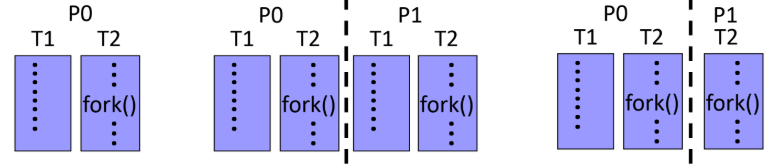
The middle image is a fork that duplicates all threads, while the right image is a fork that duplicates only the calling thread.
Thread Cancellation
- What happen if a thread determinates before it has completed?
- e.g, terminate web page loading
- Target thread: a thread that is to be cancelled
- Two general approaches:
- Asynchronous cancellation:
- One thread terminates the target thread immediately
- Deferred cancellation (default option):
- The target thread periodically checks whether it should be terminated, allowing it an opportunity to terminate itself in an orderly fashion (canceled safely)
- Check at Cancellation points
- Asynchronous cancellation:
Signal Handling
- Signals (synchronous or asynchronous) are used in UNIX
systems to notify a process that an event has occurred
- Synchronous: illegal memory access, division by zero
- Asynchronous: control+C to terminate a process
- A signal handler is used to process signals
- Signal is generated by particular event
- Signal is delivered to a process
- Signal is handled
- Options
- Deliver the signal to the thread to which the signal applies
- e.g. sleep
- Deliver the signal to every thread in the process
- e.g. process is killed
- Deliver the signal to certain threads in the process
- Assign a specific thread to receive all signals for the process
- Deliver the signal to the thread to which the signal applies
Thread Pools
- Create a number of threads in a pool where they await work
- Advantages
- Usually slightly faster to service a request with an existing thread than create a new thread
- Allows the number of threads in the application(s) to be bound to the size of the pool
- # of threads: # of CPUs, expected # of requests, amount of physical memory